

Intuitions built from experience
Mostly, awareness of the gap between reality and a situation (our subjective perception of the situation) happens intuitively.
This is a very fast process, it's even more like a feeling.
Such tasks are processed by fast S1 thinking according to Kahneman, which compares facts/features related to the evaluated phenomenon, and facts/features from some "database" that is filled with our explicit and implicit subjective experience throughout life and work in subject areas.
S1 thinking according to Kahneman is an automatic, fast, and intuitive way of thinking. It works without conscious effort, based on associations and heuristics, allowing us to react almost instantly to situations. This thinking requires little energy, is based on habits/experience, and is highly susceptible to cognitive biases.
When fast thinking finds inconsistencies, we feel it as something vaguely "something's not right", "they're talking/suggesting nonsense", or on the contrary, when this thinking finds consistency, matching – "I feel in my heart that this is the holy truth, everything is correct!"
It's very important to pay attention to both of these feelings, especially the feeling of wrongness. Anatoly Levenchuk in the SSM courses suggests an interesting term for this feeling: "jitter." I'm introducing it here because I like it, and I plan to use it further. Distinguishing jitter is important because it's a clear indicator of some inconsistencies of perceptions with reality or perceptions with perceptions—both need to be fixed.
Basic intuition develops kind of "on its own along the way", although it can and should be improved (trained).
Master's sense
Master's sense is another type of intuition that doesn't develop entirely on its own, and even rather the opposite.
Such intuition is the process of transition from unconscious incompetence to unconscious competence, where the latter is exactly the "master's sense".
There is a "competency square" that perfectly displays the path through which this type of intuition develops:
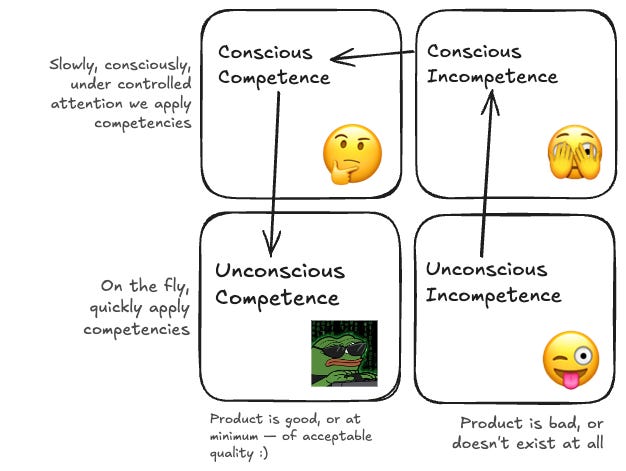
At the very beginning of work in a new subject area, when we're just learning, we can't even say what we don't know. This is unconscious incompetence. Gradually, we develop skills, and mastery, until this mastery is elevated to automatic application.
At this stage, we begin to notice inconsistencies in our own or others' words (spoken or written), documentation, and other sources of information.
If we have a problem with emotions and self-control, then having such a degree of applied mastery, one can start "getting angry at the surrounding idiots", but this is a big problem and a topic for a separate conversation. In any case - pay attention if you notice such consequences of jitter in yourself, this is a destructive pattern and generally a sign that you need to work on basic mastery of composure. There can be many reasons, both biochemical (simply problems with hormones that you don't know about or know, but don't allocate enough strength and attention to fight them), and psychoneurological. The latter seems to be easier to work through, but this most likely requires professional help.
“Fundamentally first” skill of catching jitter
Both types of intuition are needed and important, it's useful for us to both know about them and consciously develop them.
Timely awareness of jitter is one of the basic types of applied mastery of composure that's very important for us to hone.
The problem here is that we can too often either not be aware of these inconsistencies, or let them "in one ear and out the other". Such skipping happens because we don't realize how important an indicator this jitter is, and we don't know how to work with it at all.
Well now, I hope, we've realized the importance. But how to work with it?
Ground the gap.
By grounding, I mean that we should base our reasoning on real-life metrics, not just on our subjective ideas, which are often based on other ideas or on some vague concepts. Even if these ideas were initially based on real metrics, they tend to become obsolete, so we need to continuously gather fresh reality metrics and update our reasoning. That's basically the essence of Data-Driven Development.
But of course we are far from world where everybody understand that, and already completely aware of it. Thats why we should train a skill of catching jitter, so we will be able to ground the gap. How so?
You can start by catching semantic patterns in communication with colleagues, and in communication with "yourself".
Such communication patterns may include:
Vague, confused answer to a question - answer without confidence, with stumbling, hesitations. Lack of confidence and specificity in the answer may, and often indicates, that the words are little connected with reality;
Phrases like "seems possible", "well in principle we'll do it", and "theoretically doable" sound - the loudest signals of a break with reality, require immediate intervention.
Too long, drawn-out answer to a quite specific, almost closed question - the person answering the question either didn't understand the question, then we need to clarify it ourselves. If after clarifying the question the answer is still too vague - we need to pay more attention;
And conversely, too quick an answer to a question which (as we know) requires some analysis and reflection - for example, the universally loved task size estimation, the developer instantly replies "I'll do it in two days";
Vague phrases without grounded specifics - "We're making a digital product", which one? "we're developing fintech API" - which one? What features? "We're producing packaging" - what kind? Cellophane bags? Cardboard boxes? Dry cast iron containers with spheroidal graphite for radioactive rods?
These are basic examples to start with. With the development of mastery of attention to jitter, we develop our signals, we can say that we fill that "database" for intuition, which we talked about earlier.
Next time, we'll talk more about "grounding," "reality," how to see them, and what might block a clear view. If you found the material even a little valuable, please support me with a subscription. I'm really happy for every new subscriber ❤️🔥