Hello dear readers.
In previous letters about Systems Thinking in the context of learning about rational work, we discussed what focus means, what mastery is, and the main problem—the gaps between reality and our subjective ideas.
The short conclusion – rational work can only happen where there is grounding in reality.
Many insights from masters across different practical fields are based on this idea, but everyone talks about it in their language. Systems thinking and engineering pursue a more specific goal – to develop an understanding of first principles and mastery in applying them, regardless of the practical field.
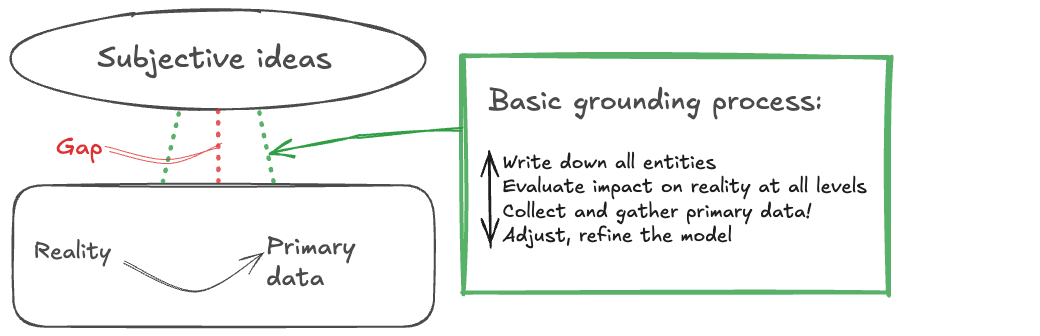
As a reminder, by grounding we mean a process in which we try to base on reality any of our ideas, transformations/optimizations in a company, and by the end of the day – any other kind of activity.
Plus, without any popular and good methodologies and best practices, we can achieve excellent progress just by relying on fundamental principles.
Let's define a basic practical methodology with which any long-term grounding and vision of reality will begin.
Pay attention to the long term. Once we have achieved some mastery in focus and responding to “Cognitive Noise,” we can begin to think and speak in the right direction.
The problem with just "thinking and speaking" is that the results of such a process quickly escape from our heads, and next time we'll have to "think and speak" almost from scratch – and it's, in fact, far from certain that it will be as fruitful as the first time!
Basic Methodology
When you, as a person with decision-making power (director in a company, head-of-something, or these decisions concern you personally and your life) are about to make decisions, first thing you are necessarily got to do is to sit comfortably and write down all entities and processes in the real world that your decision may affect, trying to understand how it will be affected and to what extent.
This "how and to what extent" is practically impossible to track if we don't establish the entities that will change, and there can be so many things that it's simply impossible to remember them all in your head. This is another reason why you need to write things down.
You definitely need to write down and externalize the results of your work into the real world so that later there will be something to continue working with, clarifying and improving this physical representation of reality. At this first stage you can write without trying to do it immediately in some efficient format – we will study the best methodologies in the future. You just need to write, write somehow in terms of form, but as detailed and grounded in the reality as possible in terms of content.
It's easier to look at your own activities, and they will likely involve fewer people than in the organization or team where you work – at minimum your family, so you can start practicing this way.
The main thing is not to consider some made-up cases – this will bring almost zero practical benefit, because the disconnect from reality here can be phenomenal.
We are learning how to ground into reality, so what is the meaning of grounding into non-existent cases, which most likely comes from internal subjective ideas? Useless work.
Thats why it's highly desirable to start attempting to ground in your work or business as soon as possible – the bigger the "situation" for modeling, the better – the more useful experience we can extract.
When "developing grounding" for situations and decisions in a large company, we need to trace all "entities and effects" at all scales:
How the decision will affect the company, and what will change in its main work, outcome?;
How it will affect departments or divisions (if they exist) - how will their work change? what will speed up (or slow down)? Will communication between departments suffer from your innovations?;
What and how will change at the team level;
And finally – how the changes will affect individual employees.
Analyzing possible consequences as thoroughly as possible, we will start identifying all the hidden problems that we might not have thought about at all, faster and faster.
If we're talking about a company, then this is of course just a starting point. We can't ground ourselves qualitatively alone.
Thats why this grounding process in the company will spread to other people in it. Thus, based on our initial attempt to ground, we should continue the process by talking to a bunch of people, checking our written assumptions, clarifying them, and grounding our model even more and better. This is the way.
The key thing in all this is focus on reality.
The problem is that we still can sit down to write something "off the top of our heads" based on our subjective representations 😁
For example, we have a reformative idea, and we have representation about what departments, teams, employees there are in the company, representation about how they work, possibly even about their problems and needs. It's very difficult to understand what these ideas are based on; most likely they somehow formed on their own during our time working at the company. It's far from certain that these ideas have any real basis if we don't constantly-periodically communicate with all departments, managers, and employees for the purpose of grounding.
Additionally, we have an subjective idea of how and what our reform will affect. This can be very, very vague, but pretend to be "rational" until we start grounding it too.
There's nothing stopping us from pouring all these ideas onto paper, especially if we're good at writing, but they will remain subjective.
Something similar happens when a high-ranking boss says, for example – we're implementing pure scrum.
Okay, but… without any additional definitions, goals and at least somehow clear instructions. Then managers enthusiastically run to implement this idea without asking clarifying questions (what if the Boss will think I'm an idiot and fire me?), pushing unclear tasks lower and lower.
Who is doing what, and for what purpose in such a scenario – is completely vague.
Writing this post, I remembered a real-life story. At one of my previous jobs long ago, a colleague told me that when he worked as a system administrator at a factory, they had a Microsoft Server with an MSSQL database, everything worked well year after year, and was even occasionally updated 😂. One day the director comes in and says – "We need Ubuntu."
Literally, that's practically the entire useful payload he put into the order - “We need Ubuntu.”
To the natural questions - "Why? What for?" followed answers like – "We need Ubuntu. Ubuntu is cool."
Need I say that the only rational way out of this situation the storyteller found was to quit? Without the skills we're studying in Systems Engineering, it's almost impossible to communicate with such a director and explain to him all the potential difficulties. It's like rolling a d20 with significant penalties – the chances of success are extremely low.
Lacking of data and being scared.
The next key idea – information about reality is almost always lacking.
This is (again) about not only work in organizations but also our subjective representation of ourselves. Try to trace how many of your ideas are not based on primary data, but are based on something like: "that's how people think," "it goes without saying," "everyone on social media says so," "mom taught me that," and so on.
By primary data, we will mean metrics from the real world that haven't yet gotten into anyone's "head" and haven't been processed or transformed in any way.
This can be difficult, and also – it can be scary to even think about it.
Most likely both scary and difficult! 😨
The brain understands what it's facing – a lot of work for collecting and evaluating primary data, comparing this data with subjective representation…
The process that could (will!) potentially greatly shake our precious, very stable (in the coordinate system of our already "default" ideas) picture of the world and ourselves in this world.
The process of collecting this data not only boring, slow, it is literal danger for this lazy fellow inside. And it knows it.
But the result is definitely worth it.
Don't listen to these signals, you're not a trembling creature and deserve to change your life and the lives of people around you for the better.
And in the end, it's not that difficult to start collecting metrics of reality, you can sacrifice, for example, the constant grabbing of your phone to watch short, stupid videos and spent some time writing down and finding good software for time tracking and writing notes :)
Just make a brave decision... That's the only thing that might be hard.
Lets put it that way – if you want changes, changes definitely for the better, you may need to bring your system of subjective ideas into a threat, the new way of thinking (and living) where priorities needs to be restructured toward reality, rather than subjective hallucinations.
The scientific rational approach is based on this readiness to accept this "new" reality and continue to exist in it, when it is confirmed with metrics from the real world.
Wrapping up with a silly picture :)